Chalu, the Green Parrot
Subramani Mani
Discussing inheritance is always controversial. I am not talking here about private property—land holdings, estates, bank accounts. I am thinking about physical characteristics and mental traits, such as eye color, height, nose shape, and artistic talent. Writing, painting, and music skill are predominantly acquired. I am not ruling out some innate talent. Still, there is good consensus that environmental influences dominate in nurturing and developing these pursuits. Science has not been able to resolve all the questions around evolution and inheritance. I am bringing all this up because many of you know my dad Srikanthan, a well-regarded writer who passed away last year.
*
When I was eight years old, I was enrolled in an English medium school about a mile from our home. In theory, it was walking distance. The neighborhood roads had pavements, and my friends and I would occasionally walk to school, taking anywhere from 30 to 40 minutes depending on how much chatting we did. But most days we took the school bus, which was co-ed, noisy, and a lot of fun.
My mom, dad, and I lived in a modest single-family home in a middle-class subdivision. But our home felt different from the houses of most of my friends. It was full of books and paintings, not surprising at all—my dad was a writer and my mom an art teacher. We had a small front yard with a garden where we nurtured many plants. (My mom was fond of flowers; she thought art and flowers made merry company.) The front door opened into a big hall which combined the living, dining, family, and kitchen areas into one cavernous space endowed with a high ceiling. The walls were mostly lined with floor to ceiling bookshelves, even blocking out a few windows, but leaving some space for paintings to keep my mom from protesting too much. Any visitor to our house could sense a tug of war between books and pictures for living and breathing space, for existential predominance. The books seemed to be winning, so that our home bore an eerie resemblance to the British Council Library in its atmosphere and ambience, but with two clear distinctions: our square footage was a third less, and about half the books in our household were in Malayalam. (Many others were in Tamil, a language Dad learned in elementary school.)
My parents’ bedroom also contained books and art, as did mine, which had a couple of short bookshelves that held my school books and a few other books I had received as birthday gifts. In a way, my mom had a dominant presence in my room: there was more art than books. Most of the paintings in our home were created by my mom. Besides teaching art to elementary and middle school students, making art—mostly oil paintings and some watercolors—was her passion and hobby. Mom was not a famous artist—she gifted many of her pictures to friends and colleagues—but I loved her pictures, especially her watercolors. Dad appreciated her paintings as well, and encouraged her pursuit of artistic excellence.
My parents were not religious. I can’t tell if immersion in literature and art was the cause. Not all writers and artists are secular, agnostic, and rationalistic in their approach, I know, but most tend to be distributed in that space. We didn’t have pictures of gods and deities, like I saw in the homes of some of my friends. Instead, in addition to my mom’s artwork, we had framed prints of the works of Ravi Varma, M. F. Hussain, and a few European masters—including Van Gogh, Picasso, Rembrandt, Monet, and Roerich—which Dad had brought back from his travels to European countries as part of various writers’ delegations.
After I turned eight, I was allowed to read any book I wanted. Access was restricted to my dad’s study, which occupied an enclosed nook in a secluded corner, and my mom had cleverly arranged most of the adult books on the upper shelves. But as my friends and I grew older, we started accessing them. There was a sturdy wooden stepladder available to us, and we would climb up to reach the higher shelves, our curiosity kindled by a title or cover.
Beginning with Enid Blyton—the Secret Seven and Famous Five mystery series—I moved through Indian folktales—Panchatantra, Tenali Raman, Jataka, Birbal—and then got hooked on the Arabian Nights and Indian epics and mythologies—the Ramayana, and the Mahabharata. I soon started to read short stories by prominent Indian authors such as Rabindranath Tagore, Sarat Chandra Chatterjee, Amrita Pritam, Ismat Chughtai, and Saadat Hasan Manto. The last two authors my mom had placed on the upper shelves as they dealt with more adult themes.
I read more books in English than Malayalam. It helped that I was enrolled in an English medium school. And even though my dad wrote his stories and novels in Malayalam, he had amassed a huge collection of English books—mostly fiction, but a good selection of literary criticism and poetry too. At home we talked in our mother tongue which was Malayalam; I spoke a mix of English and Malayalam with my classmates but interacted with my teachers exclusively in English, which they insisted upon. Gradually, for all practical purposes, English emerged as my first language.
*
This happened one weekend when I was in fifth grade. I was reading The Adventures of Huckleberry Finn, sitting on the living room sofa. My dad was watering the plants in our garden. Mostly, my mom took care of the plants, but Dad helped out from time to time, especially during weekends. He said that gardening relaxed him; sometimes, while tending to the plants, he got new story ideas, or new trajectories and trails when he was stuck.
Through the window, I saw a young man and woman walking hesitantly towards our house. They looked like college students, likely in their late teens or early twenties. Dad was wearing khaki shorts and an old yellowish shirt while pulling out some weeds. He had turned forty a month earlier. He still had a full head of black hair, with very few graying strands. He was a little chubby, but looked young for his age and literary standing. (“Your dad looks so handsome,” my friends would say to me, and I was always happy to agree with them.) With confused looks, the two guests shook their heads. They must have thought he was the gardener. Getting closer, the man asked Dad, “Is SK sir in?” Dad looked surprised. Washing his hands quickly with water from the garden hose and drying them on his shorts, he said, “Come on in,” and led them into the house. Pointing them to the sofa, he took a seat on a nearby stool. “What brings you two here? What can I do for you?”
Now convinced that the gardener was SK himself, the young man started speaking, an embarrassed look on his face. “We’re organizing a language policy symposium at our college next month. We came to invite you as a key speaker.”
Dad mulled over the request. “What sort of language policy do you favor?”
The young woman perked up. “We advocate a two-language policy—mother tongue and English. I’ve noticed in your writings that you support the teaching of both Malayalam and English in our state.”
“As you know I mostly write in Malayalam,” Dad said. “We have a good collection of books, both in English and Malayalam; I would say more of English. I also have a collection of Tamil books in my study as I was born in Tamil Nadu, and as a kid learned Kural, Bharathiyar songs, and Thenali Raman stories before moving to Kerala. See, my daughter over there is reading an English book.”
Both guests turned towards me. They looked surprised to see a little girl holding a thick hardcover of Huckleberry Finn in English.
“Wow! In school I read only an abridged version of Huckleberry,” the young man said.
“Yes, she is getting an early exposure to literature. And, sure, I’ll be happy to talk at your language meet. Just remind me a few days ahead of the actual date.”
The students thanked my dad and took their leave.
*
I accompanied my dad to the event. He talked about the benefits of learning English at a very early age, starting from elementary school. His main point was that, like it or not, English is the predominant world language, and is likely to remain so for a very long time. A significant proportion of the global intellectual output—artistic and scientific—gets published in English; most of the important publications in other major languages also are quickly translated into English, he said. To a question from an audience member—if we focus on English, won’t that result in the neglect of our mother tongue—he responded, pointing in my direction: My daughter sitting over there started focusing on English from her kindergarten days. Her command of English is excellent. She is also learning Malayalam, but sometimes I feel she is lacking in the language; she enjoys reading English books more. He continued, no Indian language comes close to English, Spanish, French, or German in terms of the capacity to express intricate concepts in different fields of knowledge. We have no choice—we need a major language, in addition to our mother tongue, to acquire critical knowledge and advance in life.
*
In high school, my readings transitioned from Huck Finn, Oliver Twist, David Copperfield, and The Old Man and the Sea, and gravitated to Madame Bovary, Crime and Punishment, Lady Chatterley’s Lover, and Lolita. During this time, I started writing short stories, a few of which found their way into school magazines, and then into local literary journals.
English became my creative writing language. My Malayalam was decent, good enough for school, but I couldn’t express myself creatively in my mother tongue, and English remained my favorite language for writing stories. None of my friends were into writing, and I found, too, that I was the most sensitive in my circle of friends. Small hurts and slights in our relationships would upset me a lot. This also extended to happenings in the world; wars and other injustices exerted a tremendous influence on my mood, even to the point of distracting, disabling, and decommissioning me from my daily routines on certain occasions.
*
I graduated from high school, and within a few weeks my eighteenth birthday arrived. I celebrated the milestone with my friends, most of whom had already crossed the border of adulthood. Meanwhile, I had been accepted to a prestigious undergraduate English literature program at Delhi University which would start in Fall.
Earlier that Spring, I had wandered into my dad’s study and found a working manuscript in English which turned on my curiosity: a sheaf of papers, handwritten, with lots of overwrites and corrections. The Green Parrot, read the title page. It seemed like a novel or novella in progress; why in English, I thought. I left the manuscript as I found it and thought I would ask Dad about it later on. But I totally forgot until my birthday, when Dad handed me a gift-wrapped package. “A novella I wrote in English,” he said.
“Congrats, dad, for daring to write in English,” I said. “I didn’t know it had already been published. And I didn’t come across anything in the press heralding the milestone.” I said this looking askance.
An amused and quizzical look came upon his face. “I wrote it for you; it is a gift I am giving you.”
Confused, I asked what he meant.
He looked thoughtful. I didn’t find much conviction in his eyes. “Green Parrot is a little futuristic. The best time for it to be in readers’ hands is 10 to 20 years from now.”
“You’re giving me the original handwritten manuscript; is that so?”
“Yes. You can use it however you want. Even edit it. Read it only when you’re getting ready to publish it, preferably after I am history.” He continued, noting my perplexed look, “I know you want to be a writer. A writer’s life, her journey, is like traversing a Himalayan glacier, full of treacherous crevasses, unexpected snowstorms, and avalanches. Like a climber, a writer might need to be rescued or helped at times with some hand holding. Writing is a long lonely trail with a high level of difficulty, and unforeseen challenges crop up as you try to find your way, Suru.”
He looked at me tenderly, his eyes moist. I hadn’t seen him this emotional in a long time. “I am proud that you’re embarking on this vocation. Yes, some call it a vocation, but I prefer to call it an adventure or aspiration. Keep at it; stay the long course. It is not a sprint; it is an ultra-ultra-marathon; I would say a life-long marathon, with water and nourishment breaks, and time set apart for other joys of life; my blessings will always be there for you.” Saying this, he hugged me tight. I noticed tears well up in his eyes and start to trickle down his cheeks. I clutched the packet with some trepidation, and securely deposited it in a drawer at my desk. I soon forgot about it.
*
After finishing undergrad, I stayed in Delhi to pursue graduate studies. I carried on with my writing, publishing stories throughout my undergraduate and grad school years. My parents remained in Trivandrum.
I visited them frequently in the early days. But when I got busy with classes and my writing, my visits became less frequent. My dad was productive, keeping a good pace in his writing; he came out with a new novel every two years or so. He continued to write in Malayalam while I wrote in English. By the end of grad school, I had finished a novel; it was published by a small press in Delhi and received some critical appreciation.
Dad knew how hard it is to make a living as a writer. He advised me to take a job, and continue to write. That was what he had done. He had taught at a school early on his writing journey. But within a few years his books had started selling well, which enabled him to focus solely on writing.
I took his advice and started as a lecturer at a college affiliated with Delhi University.
*
At the relatively young age of 59, my dad was conferred the Jnanpith award, the highest literary award in the country. We were all thrilled. Dad, accompanied by my mom, came to Delhi to receive the award. Mom and I watched from the front row along with other distinguished guests at the glittering ceremony as the President presented the award to my dad. We basked in his glory. But I was also jealous of him.
Within a year, he was gone from this world. He passed away suddenly, following a heart attack. There was a strange recurrence of the number 5 in his life. He was born on 25/05/1955 and died on 05/05/2015, a few days shy of his 60th birthday. His last novel, published earlier that year, was Brown Sands and Blooming Flowers, which was well received and sold a lot of copies.
My mom and I were devastated by the loss. My dad’s absence fell particularly hard on me. At the time of his passing, I had published a few dozen short stories, four novels, and a book of literary musings. Even though I wasn’t making a living from my writing, I felt that I was a successful writer. But after my dad passed away, I found myself unable to write, as though my writing muse had suddenly bid me farewell, and my writing stream had dried up. I started spending more time in Trivandrum to be with my mom; she was in no mood to come to Delhi.
Writer’s block or writer’s drought can feel like clinical depression: palpable, like a wind chill on your psyche. A feeling of helplessness sets in, and you sit ogling the white space in front of you while the tip of your pencil maintains its posture at a safe distance from the paper. Sometimes, you feel like a kingfisher perched on a branch, looking down at a polluted stream with no live fish to feed on. Or you feel like a fisherman, clutching a fishing rod, watching and waiting and finding nothing to take the bait. Words seem to swim away from the tip of your pencil.
My dad had co-created me with my mom. After I was born and the umbilical cord was cut, I became an independent entity. But with writing, it didn’t seem that way. Like a mighty river feeding its downstream branches, my dad’s writing heart had pumped out words, phrases, and sentences, filling me with inspiration. When my dad’s heart stopped beating, the inflow stopped and my pen dried up.
*
One day years ago, my best friend’s dad had visited to chat with my dad. He had recently retired from college after teaching for 15 years. He had been a wanderer if not exactly a vagabond. In college, he had become an activist and took more than a decade to finish his degree. In graduate school he was the same, taking a dozen years to complete his doctoral degree. A few postdoc stints before becoming a full-time faculty member had taken him another six years. “The resort manager seemed surprised when I told him I had retired after teaching for 15 years,” he told Dad of his recent stay at a beach resort in Varkala. “‘Why didn’t you continue teaching?’ he asked me. I mulled over his question for a few seconds. ‘Good question, manager; see, after high school I studied for almost three decades; that is a total of 40 plus years of studies. But after teaching for 15 years, I found that I had exhausted everything I learnt. If I wanted to continue teaching, I would have to go back to school. Do you really want me to do that, manager?’ He seemed surprised, and then looking into my eyes he remarked, ‘No, you don’t need to go back to school. This is the time to read by the beach, and maybe even write!’ Saying this, he laughed.”
*
There are times when you feel you have a lot to say. Words flow, like a waterfall or stream, in continuous motion. That was how it was for me when dad was around: as if there was a strange connecting thread, a wireless connection with a flow of words from my writer father to his writing daughter.
With his death, the writing cord snapped. Human physiology and cognitive science tell us that nouns form in the heart, verbs in the brain; they then travel down through the circulatory and nervous systems to the tips of our fingers. But no noun or verb would arrive at the tips of my fingers to be strung together into stories. It was as though my heart and brain had frozen, gone into a lockdown mode.
*
The new kid on the block was Chalu, the Green Parrot. It had been unleashed on the world to solve all of its problems, like a genie. I decided to try all the AI models including Chalu to write my stories. One after another, I read the stories they spat out. Not one moved me, no tears came to my eyes, none made my heart race, my breathing labored, my brain dizzy, or my body sweaty. There were no feelings, no emotions, no natural beauty in language. The knowledge that it was all made up by a silicon wafer circuit likely turned me into stone while reading these artificially contrived stories. Thinking evolved in a pulsating brain over many millennia; I couldn’t envision a wafer circuit, however cleverly assembled, as a substitute for the natural one—the human thinking machine.
I suddenly remembered the gift my dad had given me on my eighteenth birthday, with clear instructions to unwrap it only after his demise. I found it and set it on my writing table. The fading wrapper with yellowing edges brought back memories of my dad and his writing life. He had been a hard worker, sitting at his desk and writing for 5 to 6 hours almost every day, as though it were his regular job. And of course it was. That was the secret to his success, I now surmised. Many days, he was absent from lunch because he was focused on his writing. He was not blessed with longevity, but he had achieved a lot in his relatively short life. His books—his story collections and novels—were continuously in print and sold well. He still enjoyed adulation as one of the leading lights of Malayalam literature; most of his works had been translated into other Indian languages and English.
Carefully, I removed the wrapper and put it away in the bottom drawer of my desk. A stack of neatly arranged, yellowing, handwritten manuscript sheets stared up at me from the table top. The title page had just one line of text: The Green Parrot. My dad’s name was nowhere to be found. Right away, I noticed a few preliminary details about the sheaf of handwritten pages—120 numbered A4-sized pages in beautiful cursive letters with no corrections. I never knew he had such beautiful English lettering. His Malayalam writing wasn’t all that elegant; it always appeared scribbled; scrambled, like the egg dish. But the manuscript before me was a total contrast: crisp one-inch margins, five to seven words per line, and exactly thirty lines of prose on every page—I only checked a few random pages—except the last page, numbered 120, which had just twenty lines of writing.
Here are the last few lines of the novella:
After a long time, the green parrot returned to its original perch on the mango tree in our front yard. It was the start of the Fall, and the mango season was over. The rains had stopped; leaves were dropping from the tree, like the branches that had broken off in the summer storms. The parrot sounded tired. Its voice was breaking, and the words came out garbled. I reached for my binoculars to take a close look at the bird. The bright green feathers had started to yellow, and I saw black soot-like speckles on the plumage. The glint and sharpness were gone from its eyes, which were now dull and glazed, like the eyes of dead fish I had seen at the Palayam fish market. Slowly, I walked back to my study.
By contrast, the opening pages were full of hope, wonder, surprise, and disbelief:
The mango tree, standing tall and majestic in our front yard, had started to bloom, foretelling its sequence of buds, flowers, tender green mangoes, and then large ripe yellowish-red fruit, like the transformation of caterpillar to pupa to colorful winged butterfly. I expected the songbirds to start arriving soon. But I was in for a surprise when I bent to water the roses, which had begun to bloom. From above, I heard a voice like a little girl’s teasing me.
“Twinkle, twinkle little star
How I wonder what you are?”
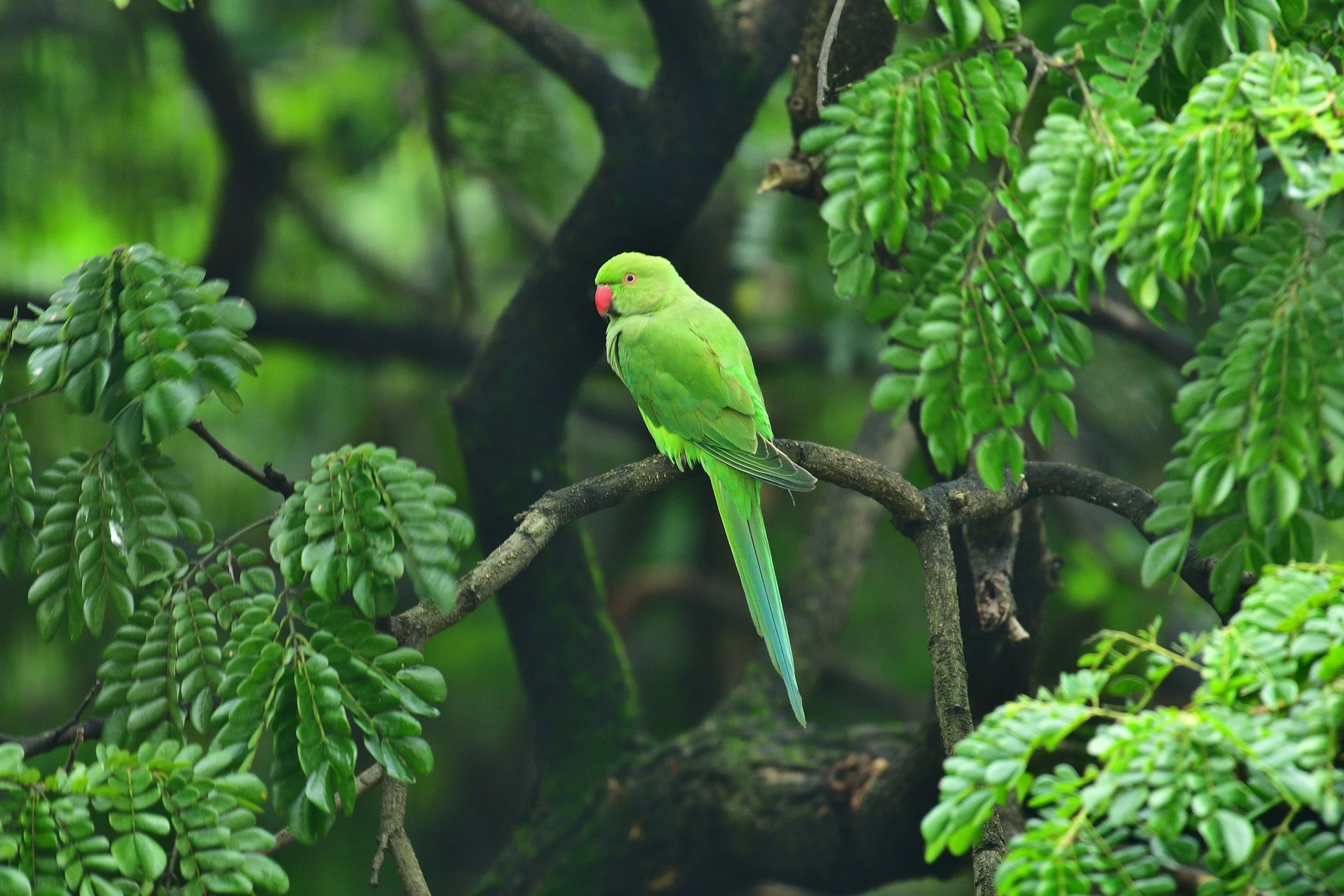
I looked up to see a cute green parrot with sparkling eyes, perched on a high branch of the mango tree. Excitedly, I called out to my daughter, “Ammu, come here and take a look.”
Ammu looked up at the parrot, her mouth wide open. The parrot jerked its head to stare at her, switching to Tamil.
“Odi vilayadu papa
Oyinthirukkalakathu papa”
“Little kid, go, run, and play
Little kid, don’t you be sitting still”
And the next morning, when I went out to the garde,n it recited a Kural as though it were advising and admonishing me—
“Karka kasadara karpavai katrapin
Nirka atharku thaka”
“After acquiring thorough knowledge
Apply it in your life”
I had been fascinated and charmed by the parrot. But that morning, I was irritated at the teasing and advise. I dropped the hose, turning and calling towards the parrot, “You’re just a parrot, no poet. You just repeat what you hear. You have no imagination. You’re just a parrot, no poet.”
The bird listened quietly. Then it jerked its head, flapped its wings, and flew away. I forgot about the parrot and went about my day.
Early the next morning, as I watered the roses near the mango tree, I heard a fluttering sound and knew that the parrot was back on its perch. I ignored it.
“Yo, listen to me
You’re just a gardener, no writer
You have water flowing through your hose
But there is no ink in your pen
No words at your fingertips
No feelings in your heart
And no stories in your head
You water the plants morning and evening
You’re just a gardener, no writer”
I was stunned. Parrots can learn from other parrots, I thought, including their peers.
For a few days after this exchange, there was no sign of the parrot. Then one hot humid morning, I was outside again tending the plants. Though it was early, I became sweaty and sticky. I could feel the weight of the humid air, the stuffiness around me. The flowers were looking lethargic, and many plants had started to wilt. The garden insects buzzed around restlessly and aimlessly. Mosquitoes were making a meal of me. I got the feeling that the parrot was back on the mango tree. It should’ve arrived during the night or at dawn, I thought. But I didn’t want to look up and confirm its presence; I was in no mood to exchange words with the parrot. I wanted to finish watering the garden quickly and go back inside the house as soon as possible.
“Hola, howdy this morning?”
I didn’t know why the parrot had suddenly switched to a Spanish greeting. Parrots have their own minds these days, I thought.
“Hello, and welcome to my garden.”
“Gardener, why have you suddenly started writing in English?”
I said nothing. I couldn’t think of a good answer; I didn’t want to be brutally honest with the parrot and reveal that the book was a gift for my daughter. There was a long pause. The parrot switched to a Hindi greeting.
“Namaste Mali (gardener), Ammu writes in English?”
I was not happy the parrot was calling my daughter Ammu, the affectionate nickname we used within the family.
“I asked a question.”
“Yes, she writes in English, so what? Why do you care?”
“After finishing it, you plan to gift it to her; she can then publish it however she wants; advance her standing as a writer?”
I dropped the hose and went inside the house. I didn’t know the new age green parrot could read my mind. I was reminded of Garry Kasparov’s remarks after he was beaten by the chess program Deep Blue in a decisive game—the program had seemed almost human.
Over the next few days, the parrot narrated crime stories and sci-fi tales to me, young adult stories to Ammu, and romance stories to my wife.
*
I read through dad’s prescient manuscript in one sitting. What a wonderful gift from a father to his daughter—from my dad to me. I estimated the length to be under 20000 words, and when I typed it out over the next couple of days, it came to a little over 18000.
My dad’s birthday gift—a novella written in his beautiful pearly hand on 120 sheets of lined white paper—became a milestone in my writing life. Unwrapping it almost 20 years after it was written, and telling this story, got me out of my writer’s block. The publication of The Green Parrot re-established the father-daughter writing channel, and the writing juices started flowing again, through my arteries, veins, and capillaries.
*
After the novella’s publication, I went home to spend some time with my mom. I woke up early one morning to water the plants. I heard a flutter of wings and looked up. A green parrot exactly like the one I encountered in my dad’s novella was perched on the mango tree. I splashed some water from the hose onto my face, wiped the water from my eyes with my hand, and looked up again. The parrot was still there; it was not a dream, not my imagination, not a hallucination. I was face to face with the green parrot.
“Good morning, Suru.” What a sweet voice, I thought.
“Good morning, Chalu.”
“Your dad is a great writer and storyteller. He has told my tale with honesty, sensitivity and beauty.”
“Thank you for your appreciation.” I didn’t know what else to say.
“I don’t know if writers are born or made. But I am certain that writing cannot be inherited. You did the right thing by publishing my story in your dad’s name.”
“Thank you, Chalu, the green parrot. You seem to know everything; you’re omnipotent.” I quickly finished watering the plants and started walking towards the front door.
“Your father created me in words, phrases, and images, and gave me my voice, like he created you in flesh, blood, and form; you see that, Suru.”
“Yes, my dear Chalu; now goodbye and take care.”
“You too, and good luck with your writing, Suru.”
I never saw Chalu, the green parrot, again. But to my great relief, my heart continued pumping out words—of different shapes, sizes, lengths, textures, colors, feelings, emotions, weight, beauty—and circulating them. And my brain assembled them—in sequence and out of sequence, like an experienced florist, designing patterns and arrangements, making bouquets and displays—creating stories, and crafting essays. My stories started to get disseminated again, and the frames of my writing life moved forward, unhindered by debris, untainted by waste.
Subramani Mani started writing late because his developmental literary milestones were delayed. In the twentieth century, he tried to be a physician, and early in this century he studied Artificial Intelligence. He later started writing, feeling the urge to share the memories of certain life experiences, perspectives, gains, and losses. He believes that honest storytelling can change us, and our world for the better. His stories and articles have been published/forthcoming in Fiction on the Web, Marathon Literary Review, Same faces Collective, The Charleston Anvil, Umbrella Factory Magazine, New English Review, Fairlight shorts, Jenny, and The Phoenix, among others. He is a first year MFA fiction candidate at Texas State University, San Marcos.