On Mass and Memory
Christie Tate
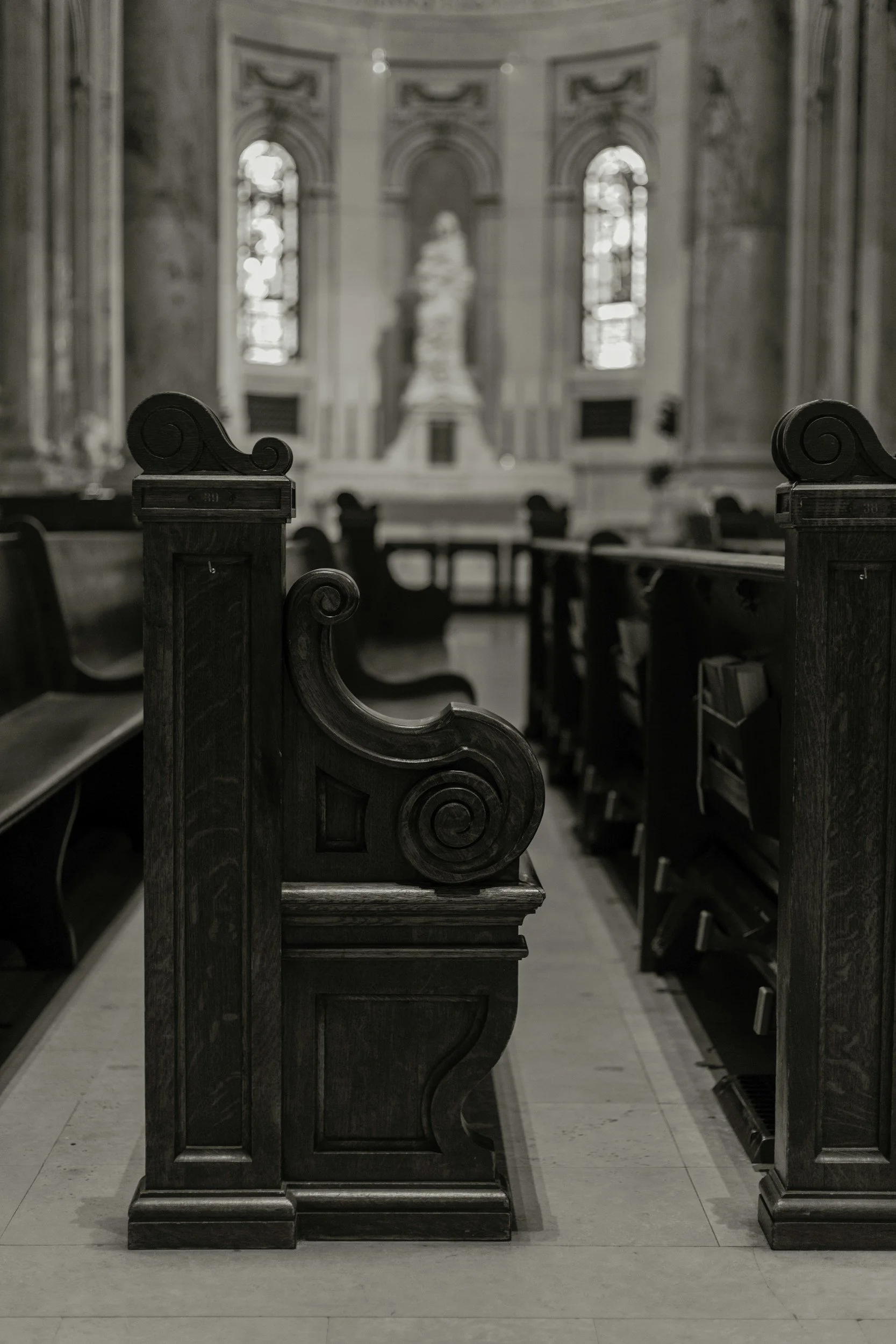
My mom and I both nod hello to the priest at the church entrance and then file up the aisle to the right of the altar. “I like to sit kind of close, if that's okay,” Mom whispers. I let her lead the way. The lighting is low, the vibe is hushed. It smells like stale incense and cold air. To our left, a group of six people sit in chairs facing the pews, not the altar. When we stand to sing the processional song, I realize they’re the choir. I expect to hear Christmas carols—Angels We Have Heard on High or Hark! The Herald Angels Sing—those were always my favorite part of Catholic Mass. But once the Mass starts, the priest—a young, thin man in his forties—reminds us that for Catholics, Christmas doesn’t start until December 25, still 24 days away. Until then, the songs are about waiting, making space, preparing for the birth of the savior. I’m bummed that we’re stuck with dirge-like O Come Emmanuel, which has no rousing chorus, no hints of joy.
During the first reading, the one from the Old Testament, I gaze around the room and try to remember the last time I attended Mass. When my now-21-year-old nephew was baptized as an infant? When my law school roommate got married? I remember going to Mass during college with a girl named Gina. Back then, I felt an all-consuming emptiness and wasn’t sure what I needed. I thought I’d find some answers at church. Or maybe I’d find a nice Catholic boy to date. Some cute ones favored the 5:30 p.m. service on Sunday evening.
I fell away from Catholicism for real once I moved to Chicago for graduate school because I signed up to live the life of the mind. No one I knew went to Mass; everyone smart either mistrusted or rejected religion. I wanted no part of the rituals or the oppression. Around that time, I joined a Twelve-Step program to address my eating disorder, but that wasn’t religion; it was spirituality and community. No infallible authority figure enforced the rules, no suspicious trove of silver and art from the Crusades distracted from the mission of healing, and the dress code was come-as-you-are. You couldn’t be excommunicated from a Twelve-Step group.
Mom’s as devout as ever. She goes to Mass every Sunday even when she’s traveling. Once, she and Dad went to the Spanish Mass in South Texas because they’d missed the English-speaking one. Today, it’s easy to look up Mass times and locations on the internet, but during my childhood, we had to drive by the churches to find out when the services were or look them up in the White Pages and call the rectory.
I wouldn’t have come today if Dad, Mom’s usual Mass companion, had been up to joining her. He’s battling a sinus infection and needed to sleep in.
Last night, when Dad told Mom he was going to skip Mass, I jumped into their conversation to tell Mom I’d drop her off and pick her up right in front of St. Thomas because the forecast showed the temperature plunging to 10 degrees. I’m a helpful daughter. I felt warm and self-congratulatory about my impending good deed. For a split second, I thought about going with her, but dismissed the thought. Me at Mass? Seemed excessive.
When morning came, my husband Jeff asked if I would consider going with my mom. Once he said it, I felt something shift inside me, like something falling into place. Of course I would go.
**
My mother’s mother read prayer cards and said the rosary before her nap every afternoon when a brief rainstorm showered Baton Rouge. I loved that Grandmother’s cheeks were always Oil of Olay moist, and her thin voice always sounded tearful. She called me “Sweet-baby” with a thick Cajun accent. She kept chocolate mint candies on the mantle and pastel melty mints in a glass vase in her formal living room.
When I was eight, Grandmother took me to a Catholic bookstore and bought me a Holy Communion book, a rosary with crystal beads, and laminated prayer cards like the ones on her nightstand. I swore to myself I’d read those cards every day and say the rosary at least once a week.
Throughout my childhood I was devout in spurts. In second and third grade, I prayed for the stigmata because I loved the thought of God finding me so worthy that he’d give me a bloody wound for everyone to see. Those years, I wanted to be a nun because my kind, attentive elementary school teachers were nuns, and it felt like they loved and cared for me. They praised my penmanship and my spelling; they gave me strong hugs; they came to my ballet recitals. In first grade, three of us dressed as Holly Hobbie for Halloween, but Sister Lynn gave me the prize because my eyes “twinkled like stars” through my plastic mask. In second grade, Sister Annell gave our class a tour of the first floor of the convent. I remember the blue couch, the TV in the living room, and how Sister Annell made fun of Sister Terri-Ann for her boisterous cheering for the Dallas Cowboys after Sunday Mass. I was gobsmacked by this glorious living arrangement: A tidy, quiet house next to school with all your fellow nuns around for company? You’d never be lonely! No older brothers to tease you, no younger sisters to siphon all the attention. It would be easy to be good in a house like this.
My Catholicism was women. It was the women in my family—my mom and her mother—and my beloved teachers. It was honoring the Blessed Virgin Mary during the whole month of May. I loved to stare at Mary’s sky-blue robes during Mass, while the priest droned on and on, no longer in Latin, but it might as well have been.
My mom’s father was a practicing Methodist who went to church in his long blue Chevy on his own every afternoon. Before my parents married, my dad, raised Southern Baptist, agreed to go to Mass every Sunday with Mom and support their children’s Catholic education. He never took Communion, nor did he convert. Mass was Mom’s deal, and it was mine too. Until I let it go.
**
I notice that some parts of the Mass are different since I was last a regular here. After the Scripture readings, the reader used to say, “This is the word of the Lord,” but now it’s truncated to “The word of the Lord.” I’m weirdly proud that I noticed that and wonder why the change? How many cardinal meetings and synods did it take to lop off the “This” and the “is”?
Mom pulls out her phone and types something. I’m shocked. What in the world is she doing on her phone like one of my teenaged children? I glance away and then back again and can see that she’s pulled up an app that posts the readings so she can follow along. Well, look at my tech-savvy mom figuring out how to live-stream Mass! She really is devout.
A young girl—not more than two years old—runs up and down the aisle. She’s wearing a red plaid dress, white tights, and black Mary Jane’s. Her baby fine hair, pulled into a hair tie, sticks straight up like a character from a Dr. Seuss book. Her parents, seated in the second row, smile at her with adoration. Her dad’s in charge of wrangling her back if she gets too close to the altar or disturbs anyone sitting on the aisle. Her mom wears a head covering and holds a tiny baby the size of a sub sandwich, which explains the look of glazed exhaustion on her face. I flashback to learning in religion class at St. Rita’s that Catholics used to sequester babies in a separate nursery, but then decided to let them join the congregation and roam the aisles. I’m grateful this energetic toddler hasn’t been tucked into a side room far away from the rest of us.
**
I remember a night when Dad was out of town and Mom took us to the Big Boy diner a few blocks away. If we ate all our grilled cheese and crinkle-cut fries, and we were allowed a sundae: a single scoop of soft-serve vanilla ice cream covered in runny chocolate syrup with a maraschino cherry on top and served in a small silver dish. I sat next to my brother on one side of the booth; Mom and my little sister faced us across the table. Was it my brother or I who wanted to know which sins were considered “mortal”?
We must have heard about it at school. My brother’s teacher, Sister Anne, had a fascination with the morbid, and wouldn’t hesitate to educate her pupils about which sins would cast them into hell forevermore.
“So which ones?” I asked. I was nine or ten, already worried about so much: making good grades in all subjects, earning a solo in ballet, and figuring out how to make my body skinnier. Now I had to worry about committing a special sin that would turn God away from me forever? I twisted my napkin under the table around my thumb. Forever?
“Murder and premarital sex,” Mom said. She daubed a speck of ketchup off my sister’s cheek. “Maybe others, but I’m sure about those two.”
Her words soothed my panic. I hadn’t murdered anyone and doubted I’d ever have the strength or access to weapons. As for premarital sex, I figured I could probably get through life without doing that. I picked up the crust of my grilled cheese and thought about the sundae shining on the horizon of this meal. I filed away Mom’s words—buried them, really—until I was 17 and had a boyfriend, raging hormones, and hot nights of temptation in his Honda.
**
The priest invites us to give each other the sign of peace. I remember this! As a kid, I dreaded this part of the Mass because you were supposed to turn to your neighbor, shake hands, and say, “Peace be with you.” The worst was if we were seated near someone from school—a boy I had a crush on or an impossibly popular girl a few grades ahead. Mom always told us we had to offer a firm grip and look the other person in the eye when we wished them peace.
This time, I hug Mom and then turn to the guy seated in the pew in front of me. He offers an elbow to bump, not something I ever saw at St. Rita’s in Dallas during the 80s and 90s.
The shock of an elbow pump is nothing like the surprise of pulling the Nicene Creed, a prayer recited after the priest’s homily, from my long-term memory bank only to collide with its various revised lines. From the jump, the first line has been revised from “We believe in one God,” to “I believe in one God.” I much prefer the old wording. One of my favorite Twelve-Step slogans is “this is a we program.” The first line of Step One is “we admitted we were powerless…” When I started going to meetings, I loved the we because I’d been so alone with my bulimia and compulsive eating my whole life. Over the years, I fought with every aspect of Twelve-Step recovery, but never the We.
Later, when I look up the changes to the Nicene Creed, I learn that the “I believe” is a more faithful translation of the ancient Latin text. I want to hate it, but I admire the commitment to linguistic accuracy.
I can tell other lines have slightly different wording, so I stop trying to flex my memory and just listen. It feels like being in a dream where you’re in your house, but it’s a surreal version, and the walls are orange instead of pale yellow and the yard is missing your oak tree and the white hydrangeas. I hear the word “consubstantial” for the first time ever in my life. The line formerly recited as Jesus Christ as “one in being with the Father,” has become “consubstantial with the Father.” Consubstantial. Fancy. I picture celebrity Catholics—Stephen Colbert, Conan O’Brien, Mary Karr, Mark Walberg, and Nicole Kidman—reciting this prayer with my mother.
My post-Mass research informs me that consubstantial means that the substance of Christ the Son is the same as the substance of God the Father—so Christ is both man and God—which was one of the great brainteasers of my childhood. How, I wanted to know, could Jesus Christ be both a man and a God? In high school, I asked my theology teacher Sister Sue Anne why? Why was it necessary for Christ to be both? Wasn’t one enough? I can’t remember what she said, but I remember her rolling her eyes like I should have known. “Some things we must simply take on faith.”
I wish I would have asked my mother about “consubstantial” instead of scrolling through Catholic websites. She could have resumed her post as the religious expert, and I could have been her student once more.
**
When it’s time for Communion, I want to go for old times’ sake but vaguely recall a rule that you can only receive the sacrament of Holy Communion—the wafer that the priest’s blessing turns into the Body of Christ—if you’ve confessed your sins to a priest within the last year. Or maybe it’s that you can’t take communion if you murdered someone recently or premarital sexed. I’m innocent on the mortal sin front—my premarital sex was years ago, surely erased by the statute of limitations—but since I haven’t been to Mass or confession since Clinton’s first term, I sit this one out. I watch the volunteers offer wine from a chalice to everyone who stands in line—still a shock now nearly five years after the COVID lockdown. I watch the people stream down the aisle, impressed by the diversity. It’s heartening to see so many people of different races and ages sitting quietly in these pews. In what other context would this group of people gather together? It feels like a safe space. We are eons away from the Crusades, those bloody military campaigns to recapture the Holy Lands and to halt the spread of Islam. And then as soon as I think that thought, an internal debate begins in my head. What about Spotlight? What about abortion? What about gay rights?
It’s a relief to remind myself I don’t have to resolve any debates. I’m here to support my mom. That’s it.
**
When I was 23 years old, I moved from Dallas to Chicago for graduate school. Naively, I packed only two sweaters and one pair of thick socks as my “winter gear.” By mid-October, I needed more layers. Mom shipped my lightweight barn jacket and Eddie Bauer down-filled parka to me.
I called to thank her for the package and, mostly likely, complain about the Chicago weather: Freezing cold outside, but stifling hot indoors, where clunky old radiators hissed and moaned during class, while everyone slowly removed one layer after another until we were all sitting around talking about Toni Morrisson in short-sleeved cotton t-shirts.
“I found something in the pocket of your jacket.” Mom’s voice trailed off.
“Money?”
“No,” she said, drawing it out. I knew this worried version of my mother.
“What?”
“Well,” she paused. “It looked like a lollipop, but it wasn’t candy. It was a condom.”
I flashed back to six months earlier when I walked across my undergraduate campus during a health fair. An exuberant nursing major in a red polo t-shirt thrust the condom-lollipop into my hand. I must have shoved it into my pocket. When I explained this to my mom, the concern remained in her voice.
“I see. Okay. Well, I threw it away.”
Years later, she joked about finding the “lollipop” in my jacket and my “very unlikely story” that I got it at a student health fair. The story was true, but she wasn’t wrong that I was sexually active with my boyfriend at the time. I never gave her credit for being able to laugh at her daughter’s mortal sin.
**
After Communion, Mom tugs at her right ear and pats the pew beside her. Then, she bends and searches the floor around us for something.
“I lost my earring,” she whispers.
I look on the floor and down the aisle. “Maybe it’s in the car.”
She shakes out her coat and feels around her collar. “I hate not wearing earrings. Especially on a plane.”
I smile because she says it like it’s a rule she can’t break, a kind of mortal sin. It reminds me how she used to insist I couldn’t go to Galleria or North Park mall—the upscale Dallas shopping malls—without wearing lip gloss and earrings. It was Valley View, the trashier mall with Sears and a food court, where you could shop without glossy lips or pearl studs.
**
A few times in the past I’ve tried to write about my mom, but each essay ended up being about my dad. It was uncanny how he’d take over the narrative with his larger than lifeness. Same thing when I tried to write about my Catholic Grandmother—I’d end up writing about Dad’s mom, my very Baptist grandma who regarded our Catholicism with great suspicion. Dad’s always been easier for me to write about, maybe because he was the less private of my parents. Growing up, my mom was big on “don’t tell people our business,” and I assume she still feels that way. Both times I published a memoir, I was terrified to tell her, afraid she’d see it as a violation of the religion of privacy. Both times, however, she was effusive with her love and praise. When I got my first book deal, she sent me a card, on the front of which was printed, Holy shit, you wrote a book! Where did she even find that card? Certainly, not at the Catholic bookstore, though the Holy was a perfect touch from my sincerely reverent mother.
My friend Sadia recently told me that her parents never read her books, and I felt a belated swell of pride that my mom reads mine, even though they’re full of stories about my terrible (premarital) sex and epiphanic therapy, neither of which I’ve ever discussed directly with her.
**
During the final prayers, I think about the word “mass.” “Mass” as is weight and heft. The dictionary definition of “mass” is “the amount of matter in an object.” How much does an object matter?
Here, in this essay, I’ve done a good job of letting Dad stay home under the covers, recuperating. I’ve given Mom more mass. But can we ever distribute the weight of our parents evenly? Is that possible? Necessary?
Another translation of “consubstantial” suggests that it refers not only to the divinity that Christ shared with God, but also the humanity he shared with all of us. His state of being runs both ways—toward God and toward us. I’ve always understood the humanity part; it was the God part that tripped me up. Still does.
My dad recently recorded the story of his recovery from alcoholism on a podcast. When asked by the podcast host if my mother attended Alanon, the Twelve-Step program for anyone affected by someone else’s drinking, Dad explained that Mom’s path to healing was through her church. Like Dad, I’ve opted for Twelve-Step rooms, those non-hierarchical, often rag-tag circles of strangers reading out of shared meditation books and telling their stories. Our spirituality comes not from the sanctuary, but from the basements and dank rec rooms underneath the altar where the big Sunday action takes place. I have an iron-clad respect for Twelve-Step recovery even though I recognize that there’s plenty to criticize.
What would it be like to grant my mother and her Mass the same respect I give to Dad’s and my meetings?
**
Once, in my mid-twenties, I visited my parents over Easter weekend. Even though it was April, the Texas sun was summer-hot, and I alternated between surly moping—about being single, about pending law school applications, about my unlaunched life—and soft openness—grateful to be welcomed by my parents and treated to a weekend of free meals. At some point, I complained about my short, Harry Potter haircut and how the heat was making it hard to style.
“It doesn’t look right. It’s flat—” I said, trying to fluff it with my fingers while staring into the gilded mirror in the living room.
“Like Janet Reno,” Mom said.
I bristled as if she’d tried to set me on fire. In my head, I cursed my mother. She, of all people, knew the importance of a good hairstyle. Hadn’t I spent my life waiting for her to emerge from her bathroom when she finally felt comfortable enough with her coif to venture out to dinner, to friends’ houses, to movies? Hadn’t I heard her tell me over and over how much she hated her hair, which I metabolized as hatred for mine too? How could she compare me to the then-Attorney General who was parodied on Saturday Night Live by Will Farrell in drag because it was hilarious that she towered over her male colleagues at six-foot-two with that epically tragic hair?
I said nothing to her as I slipped to the bathroom to call my sponsor. Can you believe she said that? Janet fucking Reno! I added that comment to my roster of hurts, which I carefully curated and lovingly tended. I filed the Janet Reno reference next to the time she told me stop wearing my uniform of long sweaters with baggy pants because it made me look frumpy. Or the time she called me out for eating multiple slices of bread after school instead of playing outside with my siblings. Don’t forget when she scolded me for being upset (“stop crying”) about losing the ballet solo to the thinner, more graceful sylph named Melissa. Remember when she told me that I better not be throwing up my food because I was smart and had a nice face and couldn’t that be enough?
I hoarded these stories, my shiny collection of wounds, badges of my wronged daughterhood. I’d trot one out when I’d want people to understand something about my hurt and really grasp the grave injustices of a childhood under the thumb of a Southern Belle. I loved those one-sided stories because they proved why I needed to spend my Saturday mornings in Twelve-Step meetings. Part of what I was in recovery from was a story about femininity that trapped both me and Mom.
It’s not that I’ve let the hurts go, exactly. I still trot them out—I just did two paragraphs ago! They’re there, but they don’t sting any more. It didn’t happen suddenly, like one day I discovered my heart had accepted the complications of my mother, myself, and our relationship. I’m not sure if it’s time or distance or my own flawed motherhood that has rounded the edges of each of those insults. Maybe it’s my years in recovery meetings that steered me to look at myself and consider my attachment to the stories that made a villain of my mother and a victim of me.
What I know is that one day I thought about my mom’s comment that I looked like Janet Reno and thought it was probably accurate, but more importantly: funny as hell.
**
On the way out of the church, Mom and I walk single file down the aisles toward the back where the priest sends us off with more wishes for peace. The Chicago sky is a washed-out gray-blue and the thin, cold air makes us jog to the car. The thermometer on the dashboard says it’s now 15 degrees, and I know Mom hasn’t felt anything this cold since she visited us during the 2011 blizzard. She came for a week to help take care of our toddler daughter when our son was born. I’d been terrified to ask her to come—scared of putting her out, imposing, presuming she’d want to come hang out with her granddaughter while I gave birth to her third grandson. She’d said yes on the spot—joyfully.
How had I gotten that so wrong? What was there to be afraid of?
That January, the snow fell and fell and fell—there was so much snow that the nurses kicked us out of the hospital a day early. “Go home! You may not be able to make it tomorrow.” Honestly, I wanted to stay in the warm hospital where they brought me food and took our son for a few hours at night so I could sleep. There was so much snow that Dad couldn’t get a flight to Chicago and had to stay in Dallas, settling for nightly phone calls to check on me, the new baby, and Mom. “You cannot believe this snow!” she told Dad every night. “I’ve never seen anything like it. The snow drifts are higher than the car!”
On my second day home, we took a family walk to the end of the block, and my husband recorded a video. In it, the wind whips wildly around, blowing snow upwards while it’s also falling from the sky. My mom, in a long black wool coat, black leather gloves, and a black hat, gingerly walks in the middle of the street where cars have made grooves in the packed snow. She says something that isn’t quite audible—the sound of wonder mixed with incredulity and uncertainty.
**
When we sit down to dinner hours after Mass, I slide a small ramekin across the table to my mother. It’s a pair of earrings—little gold discs. Her face lights up as she grabs them and puts them on immediately.
“Oh, I feel so much better with earrings,” she said, patting her no longer naked lobes. “I promise I’ll mail them back as soon as I get home.”
I flash forward to a day in the future when my mom might need more from me than a pair of earrings or a plus one for Mass. When she’ll need care or company—all the needs that are coming for her in the next decade or so. Great sorrow becomes a sob in my throat. I blink hard to keep from crying.
“No rush, I don’t need them any time soon.”
Please, please take your time.
Christie Tate is an author and essayist whose work has been published in The New York Times, Carve Magazine, The Los Angeles Review, and elsewhere. Her debut memoir, Group, was a NYT best seller and has been translated into 19 languages. Her memoir B.F.F. was an Apple Books and Amazon Best Nonfiction book of the year. She lives in Chicago with her husband and two children.